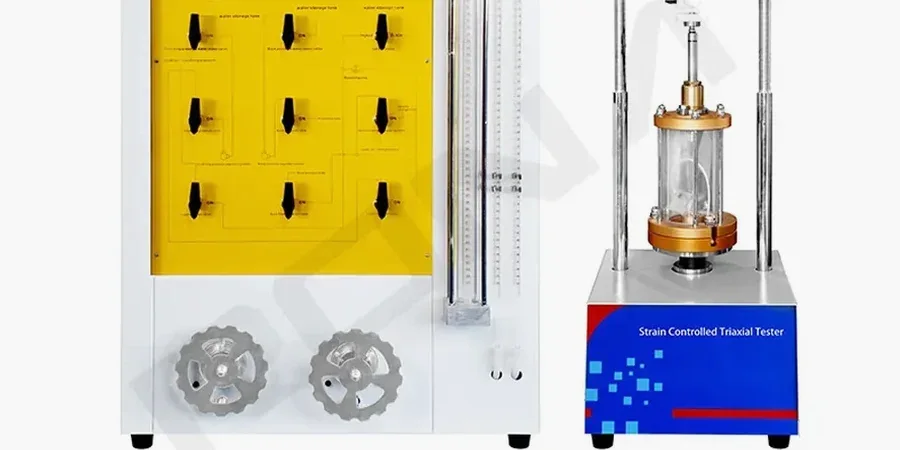
The triaxial cell sits pressurized in our lab—a clear cylinder where a 2.8-inch soil core from a West Valley City jobsite is sealed inside a latex membrane and submerged in water. Confining pressure builds around the specimen while a loading piston advances from above at a controlled strain rate, typically 0.05 inches per minute for cohesive soils. Pore pressure transducers connected to the base pedestal record undrained response, and the load cell captures deviator stress until failure. For West Valley City projects where shallow foundations bear on stiff Lake Bonneville silts, the consolidated-undrained triaxial test with pore pressure measurement provides the effective stress parameters—c' and phi'—that govern bearing capacity calculations. One test run takes three to five days from sample trimming to Mohr-Coulomb envelope, but the data it yields replaces the conservative assumptions that drive up footing dimensions unnecessarily. Many geotechnical reports for commercial buildings along 3500 South rely on SPT blow counts for strength correlation, yet when the subsurface includes sensitive silts that lose structure upon remolding, those correlations can overestimate strength by thirty percent. A well-executed triaxial shear test eliminates that uncertainty by measuring the actual stress-strain response under conditions that replicate field loading, and when combined with CPT soundings that map stratigraphic continuity, the design team gains a complete picture of soil behavior from exploration to parameter selection.
A triaxial test on a single undisturbed sample yields more usable design strength than two dozen SPT blows—because it measures what actually happens when clay fails under load.
Local geotechnical context
The International Building Code, adopted by West Valley City, requires allowable foundation pressures to be based on recognized geotechnical investigation procedures. When a structural engineer specifies a net allowable bearing pressure of 3,000 psf for spread footings on native Lake Bonneville clay, that number must be defensible—either through conservative presumptive values from IBC Table 1806.2, which can be overly penalizing, or through laboratory strength testing that captures the true drained friction angle and cohesion intercept of the deposit. Relying solely on SPT N-values to estimate undrained shear strength introduces risk in West Valley City because the silty clay layers that dominate the upper thirty feet often contain thin silt seams that drain during driving, elevating blow counts above what the intact clay mass would mobilize under long-term loading. A consolidated-undrained triaxial program removes this bias. The test consolidates the specimen to the estimated in-situ effective stress, then shears it undrained while recording pore pressure—yielding both total stress and effective stress failure envelopes. For projects near the Decker Lake area, where groundwater levels fluctuate seasonally within ten feet of grade, the effective stress envelope becomes critical for evaluating how foundation capacity changes as pore pressures rise and fall throughout the year.
Common questions
How much does a triaxial test program cost for a West Valley City project?
A standard consolidated-undrained triaxial test with three specimens (one effective stress envelope) typically ranges from US$1,920 to US$2,340, depending on specimen preparation complexity and required confining pressure range. Additional envelopes for different depths or soil layers are priced per specimen set.
What type of soil sample is needed for triaxial testing?
Undisturbed samples collected with thin-wall Shelby tubes are strongly preferred for triaxial testing. Disturbed or remolded samples can be used for reconstituted specimens, but the results will not reflect the in-situ fabric and stress history of the natural deposit beneath West Valley City.
How long does a triaxial test take from sample submission to report?
A standard CU triaxial with three specimens requires five to seven business days from sample receipt to final report delivery. This includes specimen trimming, backpressure saturation (requiring B-value verification), consolidation, shear, and data reduction. Expedited scheduling is available for time-sensitive foundation design deadlines.
Can triaxial testing be performed on sandy or granular soils from West Valley City?
Yes, but granular soils present sampling challenges. If undisturbed sampling is not feasible, reconstituted specimens can be prepared to target relative density. Consolidated-drained triaxial testing is the preferred method for granular soils, as it allows pore pressure dissipation and yields drained friction angles applicable to long-term foundation and retaining wall design.
What is the difference between CU and UU triaxial testing for foundation design?
CU triaxial testing consolidates the specimen before shear and measures pore pressure, yielding effective stress parameters (c' and φ') that apply to drained long-term conditions. UU testing shears the specimen without consolidation or drainage, providing total stress parameters (c_u) for short-term undrained conditions. Foundation design in West Valley City typically requires CU testing because the fine-grained Lake Bonneville sediments will eventually drain under sustained structural loads, making effective stress parameters the governing design basis.