In West Valley City, where the subsurface commonly consists of compressible silts and clays deposited by ancient Lake Bonneville, ground improvement is rarely optional once you get past the upper crust. The International Building Code (IBC) and ASCE 7 set strict bearing capacity and settlement criteria here, especially for structures classified in Seismic Design Category D. When conventional shallow footings fail to deliver the required factor of safety, a properly validated stone column design becomes the most cost-effective path to a buildable site. Our approach integrates site-specific CPT soundings and laboratory index testing to model composite ground behavior under both static and cyclic loading, referencing methods developed by Priebe and the more recent Barksdale & Bachus guidelines. Local expertise has shown that well-executed stone columns can reduce post-construction settlement in the Lake Bonneville sediments by 40 to 60 percent compared to untreated ground, making the difference between a project that pencils out and one that stalls at the foundation stage. Every design we deliver in West Valley City accounts for the 2,400-foot valley-floor elevation and the seasonal high groundwater that complicates excavation from November through April. For deeper characterization of the native soil profile before column installation, the CPT test provides a near-continuous stratigraphic log that feeds directly into the Priebe settlement model, while the triaxial shear test on undisturbed samples gives us the drained strength parameters needed to calibrate the composite friction angle of the stone-soil matrix.
West Valley City's rapid industrial expansion along the Mountain View Corridor has accelerated demand for ground improvement on marginal land. The stone column technique works by creating stiff, vertical inclusions that densify the surrounding matrix, shorten drainage paths, and transfer load to a composite ground mass with substantially better engineering properties than the native lacustrine clay. We've applied this solution under warehouse slabs, MSE wall foundations, and tank farms across the Salt Lake Valley, and the performance data consistently validates the design assumptions.
A calibrated stone column design in Lake Bonneville sediments can cut settlement by half and turn an unbuildable lot into a conventional foundation site.
Process and scope
The Quaternary Lake Bonneville deposits that underlie most of West Valley City present a classic ground improvement challenge: low undrained shear strength, high compressibility, and a water table that sits within 6 to 10 feet of grade across much of the valley floor. These fine-grained sediments typically classify as CL or ML according to the Unified Soil Classification System, with SPT N-values below 8 in the upper 20 feet and moisture contents that hover near the plastic limit. A stone column design for these conditions must balance aggregate gradation, column spacing, and depth to achieve the target composite modulus without generating excessive pore pressure during installation. We specify a clean, angular crushed stone meeting ASTM D448 gradation requirements, installed by wet top-feed vibro-replacement to maximize lateral displacement and densification. The design process involves iterative settlement analysis under the project's column load map, with each grid point checked against both the Priebe reduced-settlement factor and the Balaam & Booker elasto-plastic solution for cylindrical unit cells. Field QA/QC relies on a combination of modulus load tests on individual columns and post-treatment CPT soundings to verify that the composite ground stiffness meets the project specification. The design report includes column layout drawings with center-to-center spacing, depth profiles tied to the geotechnical cross-sections, and a detailed installation sequence that accounts for West Valley City's winter groundwater conditions. We also specify the pre- and post-treatment testing protocol so the contractor knows exactly what acceptance criteria govern before mobilization.
Local geotechnical context
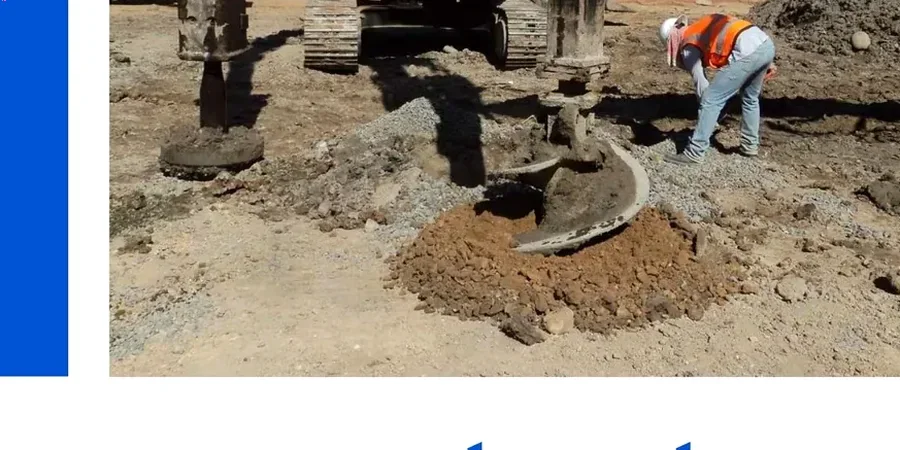
A vibro-replacement rig working a stone column pattern on a West Valley City site is an unmistakable sight: the 100-foot mast of the vibrator, the loader feeding crushed stone into the hopper, and the telltale boil of silty water at the ground surface as each column is built from the bottom up. The biggest risk we see stems from skipping the site-specific design step and relying on generic rule-of-thumb spacing. Lake Bonneville clays vary sharply over short distances — a 3-foot change in elevation can put you into a softer lens that compresses twice as much under load. Without a design calibrated to the actual stratigraphy, you get differential settlement that cracks slabs and misaligns conveyor systems. We've been called into West Valley City warehouses where untreated zones between columns consolidated unevenly because the area replacement ratio was too low for the actual clay thickness. Another failure mode is aggregate contamination: if the stone carries fines, the column's drainage function degrades and excess pore pressure builds during seismic shaking, reducing the composite shear strength when it's needed most. We specify washed aggregate and require sieve analysis on every 500 tons delivered to the site. Column depth is another critical variable — terminating short of a competent bearing layer leaves the lower clay uncompressed and creates a soft zone that can settle over years. Our designs always extend columns into the stiffer Pleistocene unit or to a depth where the stress increment drops below 10% of the overburden pressure.
Reference standards
IBC 2021 Chapter 18 (Soils and Foundations), ASCE 7-22 Minimum Design Loads for Buildings, ASTM D1586 Standard Test Method for SPT, ASTM D2487 Classification of Soils for Engineering Purposes, ASTM D448 Standard Classification for Sizes of Aggregate, FHWA-NHI-06-089 Ground Improvement Methods Reference Manual
Common questions
What does stone column design cost for a typical West Valley City commercial building?
For a West Valley City commercial project, the stone column design package typically ranges from US$1,400 to US$5,760 depending on building footprint, number of column load cases, and whether post-treatment verification testing is included. A 20,000-square-foot warehouse with uniform loading falls toward the lower end; a multi-story structure with eccentric column loads and seismic performance requirements moves toward the upper end.
How do stone columns perform during an earthquake in the Salt Lake Valley?
Stone columns improve seismic performance through three mechanisms: they densify the surrounding soil during installation, carry out drainage paths that dissipate earthquake-induced pore pressure, and create a composite ground mass with higher shear strength than the native clay. In West Valley City, where the Wasatch Fault zone governs the seismic hazard, the columns reduce the risk of cyclic softening and bearing capacity loss that can occur in saturated fine-grained soils during long-duration shaking.
What depth of soft soil warrants stone columns instead of shallow footings?
The decision point depends on the relationship between the compressible layer thickness and the foundation load. In West Valley City's Lake Bonneville clays, we generally evaluate stone columns when the soft zone exceeds 8 to 10 feet and the calculated settlement under shallow footings surpasses 1 inch total or 0.5 inch differential. The design analysis compares the cost of stone column treatment against deep foundations, accounting for the composite modulus achievable with the area replacement ratio that fits within the site footprint.
What site investigation data is required before starting the stone column design?
We need a geotechnical investigation with continuous sampling or CPT soundings through the full treatment depth, laboratory classification and strength testing on the soft layers, and groundwater level measurements across at least one seasonal cycle if possible. For West Valley City sites, at least one CPT sounding per 2,500 square feet of treatment area is recommended, along with consolidated-undrained triaxial tests on representative samples of the compressible unit. This data feeds the Priebe settlement analysis and the elasto-plastic column-soil interaction model.