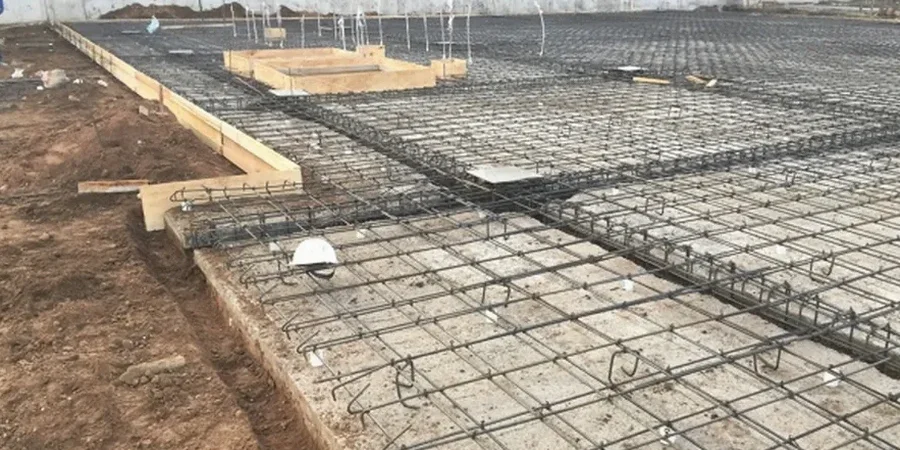
One of the costliest mistakes a developer can make in West Valley City is assuming that a conventional spread footing will perform adequately on the ancient lacustrine deposits left by Lake Bonneville. The expansive, high-plasticity clays that underlie much of the city near 40.6968°N latitude can heave during wet winters and shrink dramatically during the arid summer months, creating differential movement that tears apart slab-on-grade construction. A properly designed raft or mat foundation system distributes structural loads across a much wider footprint, bridging localized soft spots and reducing the risk of angular distortion that leads to drywall cracking and door frame racking. Before committing to a mat foundation geometry, our technical team typically recommends confirming the subsurface profile with spt-drilling to establish the depth to competent bearing strata, and we often specify atterberg-limits testing to quantify the shrink-swell potential of the near-surface clays that govern mat performance.
A raft foundation on Lake Bonneville clays isn't just a slab—it's a structural diaphragm that must be analyzed for both settlement curvature and seismic moment transfer.
Local geotechnical context
In West Valley City, we frequently encounter sites where the geotechnical report was prepared based on a single boring or an overly conservative presumptive bearing pressure, and the mat foundation ends up either dangerously under-designed or wastefully thick. The real risk emerges at the interface between the mat and the underlying soil: if the subgrade preparation is not uniform—say, one half of the mat bears on undisturbed stiff clay while the other half sits on poorly compacted fill from a decades-old agricultural operation—the differential settlement can exceed the angular distortion limit of 1/500 well before the structure is fully loaded. Another local concern is the presence of shallow groundwater in the lower elevations of the city near 111.9867°W, where a mat foundation with a basement level acts as a buoyancy raft; without a solid drainage system and an accurate assessment of the hydrostatic uplift force, the entire structure can expertise floatation or severe cracking during a wet spring when the water table rises. Our analytical work explicitly models these scenarios using finite element or finite difference software, generating moment and shear envelopes that guide the reinforcement layout in both the top and bottom mats.
Reference standards
ASCE 7-22 Minimum Design Loads (Chapter 11 Seismic, Chapter 18 Soils), IBC 2021 Section 1806 Presumptive Load-Bearing Values and Section 1810 Deep Foundations, ACI 318-19 Structural Concrete (Chapter 13 Foundation Design), ASTM D1586 Standard Penetration Test, ASTM D2487 Soil Classification (USCS), ASTM D1194 Plate Load Test (withdrawn but still referenced in many local jurisdictions)
Common questions
What is the typical cost range for a mat foundation geotechnical package in West Valley City?
For a standard commercial or multi-family project, the geotechnical investigation and mat foundation analysis typically ranges from US$1,070 to US$4,610, depending on the number of borings required, the depth of exploration, and whether advanced laboratory testing such as consolidation or triaxial tests is needed. Larger industrial projects with extensive numerical modeling may fall outside this range.
At what depth do we typically find competent bearing soil for a mat foundation in this part of the Salt Lake Valley?
Competent bearing strata—generally stiff to hard clays or dense sands of the Lake Bonneville deposits—are most often encountered between 6 and 15 feet below existing grade in West Valley City. However, the depth can vary significantly near the Jordan River corridor where softer organic silts and old channel deposits may require deeper over-excavation or ground improvement before mat construction.
Does a mat foundation eliminate the need for deep foundations like piles on poor soil?
Not always. A mat foundation is effective at distributing loads and reducing differential settlement on moderately compressible soils, but if the subsurface profile reveals very soft or organic layers extending beyond 15 to 20 feet in depth, the settlement may still exceed acceptable limits even with a mat. In those cases, we evaluate whether a mat combined with ground improvement—or a transition to a deep foundation system—is more cost-effective.
What seismic parameters from ASCE 7 does the structural engineer need for the mat design?
For West Valley City projects, we carry out the site class (typically D or E based on shear wave velocity or SPT N-values), the mapped spectral accelerations Ss and S1 adjusted for site coefficients Fa and Fv, and the seismic design category. If the mat includes a basement, we also supply the seismic lateral earth pressure increment per ASCE 7 Section 19.3 for the basement wall design.