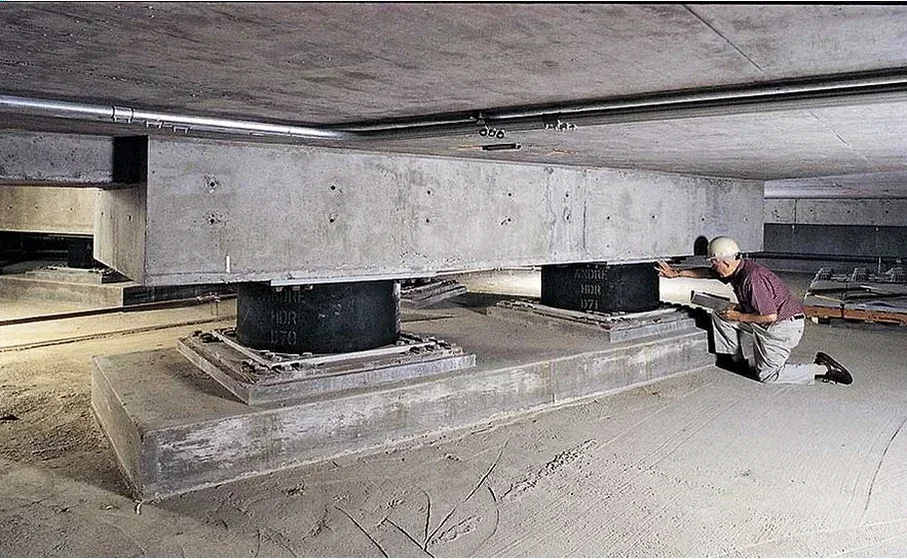
The Wasatch Fault runs right along the eastern edge of West Valley City. At 4,300 feet elevation on ancient Lake Bonneville sediments, the city sits squarely in one of the most seismically active urban corridors in the Intermountain West. A magnitude 6.5 or larger event is not hypothetical here — USGS models place it in the high-probability category within a 50-year window. Base isolation seismic design changes the equation for critical facilities and essential buildings. Instead of bracing a structure to resist ground motion, isolation decouples it. We apply ASCE 7 Chapter 17 provisions and IBC requirements to develop isolation systems tuned to the site-specific response of the valley floor. For deep soft-soil profiles near the Jordan River, we often pair isolation analysis with a liquefaction assessment to confirm that the bearing stratum will remain stable during the design earthquake.
Decoupling a building from the ground at 4,300 feet elevation on Bonneville lakebed demands site-specific spectra — generic coefficients won't capture the basin edge effect.
Local geotechnical context
We see it in West Valley City over and over: a perfectly good isolation design undermined by the utility connections. The moat — that seismic gap around the isolated superstructure — needs flexible couplings for gas, water, sewer, and electrical lines that can accommodate 24 inches or more of lateral displacement without failing. If those connections lock up, the isolation system cannot move as designed. Another local issue is the high groundwater in parts of the city near the Jordan River corridor. Isolator bearings at basement level can be exposed to intermittent submergence, which demands corrosion protection and periodic inspection access. The IBC requires a peer review for base isolation seismic design on Risk Category III and IV structures, and the review panel will scrutinize the moat detailing and the stability of the isolation interface under maximum considered earthquake displacement.
Common questions
What does base isolation seismic design cost for a West Valley City building?
Engineering fees for a complete base isolation seismic design package typically range from US$3,750 for a small single-story essential facility to US$7,860 for a larger mid-rise where nonlinear time history analysis and peer review coordination are required. The isolator hardware and installation are separate procurement items.
Does the IBC require peer review for isolated structures?
Yes. IBC Section 1708 requires independent peer review for base isolation seismic design on structures assigned to Risk Category III or IV. The review panel evaluates ground motion selection, isolator modeling assumptions, stability checks, and the moat detailing before the building permit is issued.
How does the Lake Bonneville lakebed affect isolator design?
The deep, soft lakebed deposits in West Valley City amplify long-period spectral accelerations between 1.0 and 3.0 seconds. We run site-specific response analyses to capture that amplification and size the isolators so the effective period of the isolated structure falls in the descending branch of the spectrum, where spectral acceleration is dropping off.