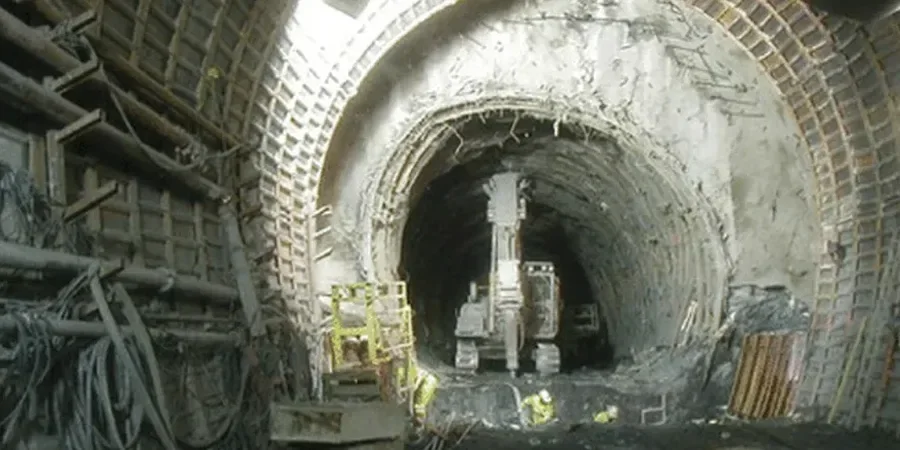
We have seen it too many times in West Valley City: a contractor brings in a TBM expecting stiff ground, only to hit saturated Lake Bonneville clays and face a week of downtime and a flooded heading. The issue is not the machine, it is the assumption baked into the pre-bid data. West Valley sits right on the eastern bench of the ancient lakebed, where soft, compressible silts and clays extend 40 feet or deeper before you hit anything competent. Without a thorough geotechnical analysis for soft soil tunnels, you are basically guessing on face pressure, settlement trough width, and annular grout take. We run the full suite of lab and field work—from undisturbed Shelby tube sampling to triaxial CU tests—to give the designer a real stiffness profile, not a textbook value. When the alignment dips under the Jordan River corridor or crosses I-215, we supplement the soft ground tunnel investigation with CPT testing to get continuous tip resistance and pore pressure data without losing sample quality in the transition zones.
Tunneling through Lake Bonneville clays without a site-specific Su profile is the fastest way to lose ground control and burn through contingency.
Common questions
What is the typical depth of soft soil tunnels in West Valley City?
Most utility and transit tunnels in West Valley City fall between 20 and 60 feet below grade. The depth is usually dictated by the need to stay below the seasonal groundwater table and avoid shallow utility conflicts along the 3500 South and 5600 West corridors.
How do you sample the soft clays without disturbing the soil structure?
We use thin-walled Shelby tubes pushed hydraulically from a drill rig, following ASTM D1587 procedures. In very sensitive zones, we deploy a fixed-piston sampler to minimize suction and disturbance. Samples are sealed in the field and transported in cushioned racks to our lab.
What is the approximate cost range for a soft ground tunnel geotechnical analysis in West Valley City?
Depending on the length of the alignment and the number of boreholes, a complete soft ground tunnel investigation in West Valley City typically ranges from US$3,940 for a short crossing to about US$16,780 for a multi-block alignment with seismic analysis and advanced triaxial testing.
How do you account for the Wasatch Fault in the tunnel design?
We develop a site-specific seismic hazard model per ASCE 7-22 that accounts for near-source effects and basin amplification. The soft Lake Bonneville clays can increase spectral accelerations at periods above 1.0 seconds, so we run equivalent-linear or nonlinear site response to carry out the tunnel liner designer with free-field displacement time histories.