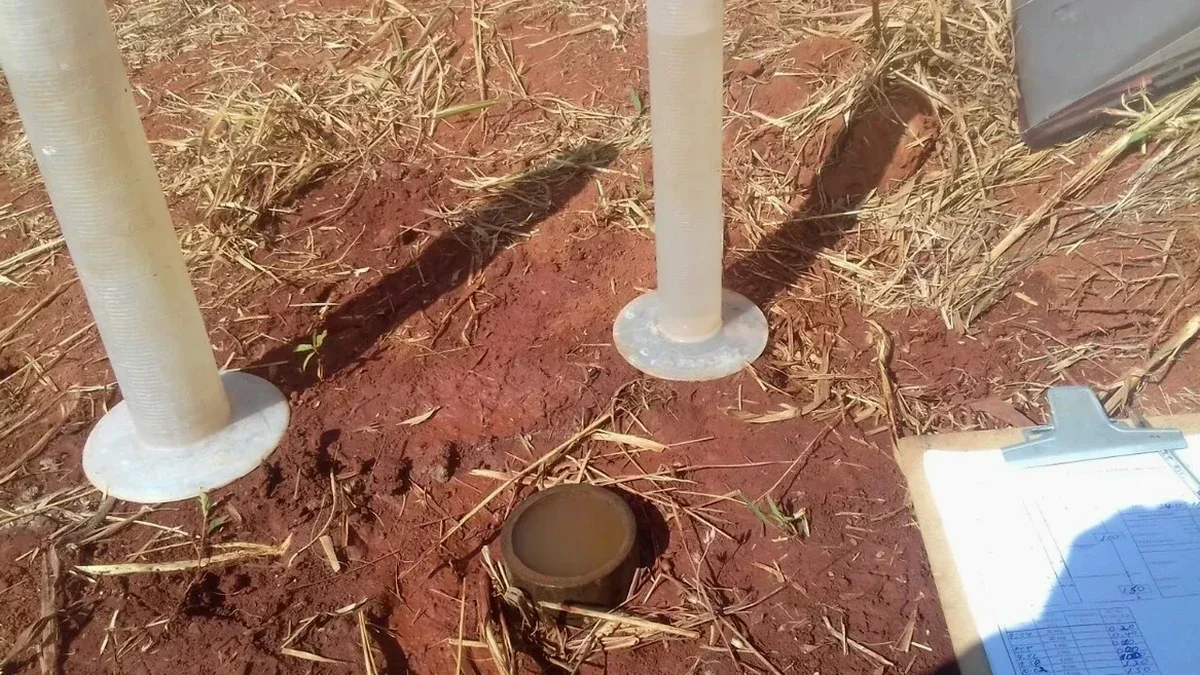
West Valley City’s expansion onto the Lake Bonneville lakebed sediments created unique subsurface challenges. What was once farmland and marshland now supports subdivisions, commercial corridors, and light industrial parks, all over complex sequences of clay, silt, and sand lenses. The saturated fine-grained deposits underlying much of the 8400 South corridor demand accurate hydraulic conductivity data before any deep excavation or foundation drain design. The field permeability test, conducted as the Lefranc method in soils or the Lugeon method in rock, measures in-situ water flow through these formations at discrete depths. Our team runs these tests across West Valley City using wireline packers and constant-head setups calibrated to ASTM D6391 procedures. For projects near the Jordan River or Decker Lake, where groundwater fluctuates seasonally with snowmelt, we frequently combine the permeability test with grain-size analysis to correlate field hydraulic behavior with laboratory particle distribution curves.
In-situ permeability measurement captures secondary porosity and macro-fabric effects that lab tests on small specimens simply cannot replicate.
Common questions
What is the difference between Lefranc and Lugeon testing?
Lefranc tests measure hydraulic conductivity in soil using a constant or falling head in an open borehole section. Lugeon tests apply to rock, using a packer to isolate a test interval and pumping water at five increasing pressure steps to assess fracture flow and the need for grouting.
How much does a field permeability test cost in West Valley City?
A single Lefranc or Lugeon test typically ranges from US$680 to US$980, depending on depth, number of test intervals, and mobilization requirements. Multi-depth profiling across several boreholes reduces the per-test cost.
How long does a Lefranc test take to run in the field?
A single constant-head Lefranc test takes 30 to 90 minutes once the drill rig reaches the target depth. The time depends on soil type: low-permeability clays require longer stabilization. We typically schedule one to two tests per drilling shift.
Do I need a permeability test for a residential foundation in West Valley City?
Most single-family homes do not require it. However, if your lot is within 500 feet of the Jordan River or a mapped wetland, or if a basement will extend more than 4 feet below the seasonal high water table, the city may request hydraulic conductivity data for drain design.
What borehole diameter is needed for these tests?
Lefranc tests can be performed in boreholes as small as NX (3-inch) diameter, though 4- to 6-inch holes carry out more reliable results. Lugeon tests in rock typically use NQ or HQ core holes with a pneumatic packer seated in competent rock above the test interval.