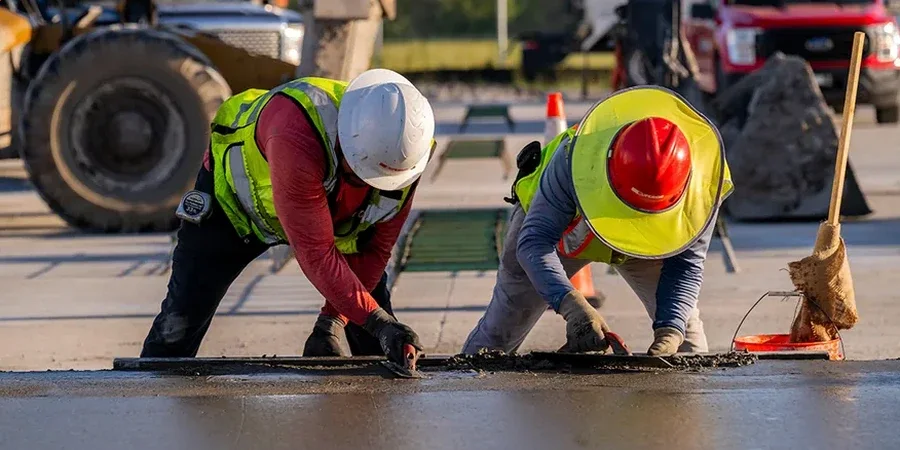
West Valley City sits on the eastern edge of the Basin and Range Province, where ancient Lake Bonneville left behind deep lacustrine clay deposits. These silty clays shrink when dry and swell with moisture, creating constant movement beneath any slab. Rigid pavement design here cannot rely on generic thickness tables because the subgrade modulus shifts dramatically between August and February. Our laboratory team runs California Bearing Ratio tests on undisturbed samples from every 500 linear feet of alignment, cross-referencing results with the soil's sulfate content to prevent ettringite formation in the concrete matrix. The 4,300-foot elevation means ultraviolet exposure degrades curing compounds faster than at sea level, so we adjust membrane application rates accordingly. For projects near the Jordan River corridor, where groundwater fluctuates within 18 inches of grade, we pair plate load testing with long-term swell potential analysis to verify the modulus of subgrade reaction before a single cubic yard of concrete arrives on site.
A rigid pavement on West Valley City clay lives or dies by its subbase drainage—skip the edge drains and you'll be patching joints by year seven.
Process and scope
The soil profile changes noticeably between Granger's older alluvial terraces and the newer developments west of Bangerter Highway. In the eastern sections, layered gravels provide fair drainage but often contain cobbles that create point loads under slabs—one reason we specify a minimum 6-inch granular subbase with fines content below 8 percent per ASTM D1241. West of Bangerter, the dominant soil is the Lake Bonneville clay unit, with plasticity indices routinely exceeding 30. Here the rigid pavement design must account for a K-value that can drop below 100 pci after a wet spring. Our lab quantifies this through soaked CBR testing and direct K-value measurement in test pits at the proposed subgrade elevation. We also examine sulfate concentrations; values above 0.10 percent by mass trigger a switch to Type V cement or blended cements with fly ash content between 25 and 35 percent. Joint spacing becomes another variable: for slabs cast on high-PI clays, we shorten panel dimensions to 12 feet or less to control curling stresses, and we evaluate dowel bar placement with finite element models calibrated to local temperature gradients. The difference between a 20-year and a 30-year pavement often comes down to how thoroughly the subgrade moisture condition was characterized before the mix design was locked.
Local geotechnical context
At 4,300 feet elevation, West Valley City sees an average of 54 inches of snow annually, and the ground experiences roughly 90 freeze-thaw cycles each winter. Each cycle pushes moisture upward through capillary action, saturating the subgrade just beneath the slab. When that saturated clay freezes, heave forces can lift a 10-inch slab by a quarter-inch or more at panel corners. The risk compounds in industrial park areas where truck traffic applies 80-kip tandem axle loads at the same time the subgrade support is weakest. Our pavement evaluation program includes frost-susceptibility classification per ASTM D5918 and drainage coefficient analysis using data from the nearest NOAA weather station at Salt Lake City International Airport. Without this level of specificity, a rigid pavement design becomes a gamble that the drainage layer will handle a spring thaw that dumps two inches of rain in 24 hours—a scenario West Valley City experienced in May 2023.
Reference standards
ASTM D2487 (Unified Soil Classification System), ASTM D1586 (Standard Penetration Test), ACPA (American Concrete Pavement Association) design guidelines, ASTM D1196/D1196M (Nonrepetitive Static Plate Load Tests of Soils), ASTM C131/C131M (Los Angeles Abrasion for aggregate quality), ASTM D5918 (Standard Test Methods for Frost Heave)
Common questions
How much does rigid pavement design cost for a West Valley City project?
A complete pavement investigation including subgrade sampling, laboratory testing, and pavement design typically ranges from US$1,740 to US$5,460 depending on the alignment length and number of borings required. Projects extending over 1,000 linear feet fall toward the upper end because they need additional test pits and more extensive sulfate profiling.
What subgrade K-value is typical for West Valley City soils?
It depends on the soil unit. Eastern terrace gravels often deliver K-values between 150 and 250 pci. The Lake Bonneville clays found across much of the city drop to 80–130 pci when saturated. Our lab measures this directly with plate load tests rather than relying on correlations, because the clay's sensitivity to moisture makes textbook correlations unreliable.
Do we need dowel bars for rigid pavement in this area?
Yes, dowel bars are standard for any rigid pavement carrying truck traffic or spanning joints in West Valley City. The high plasticity soils lead to differential vertical movement at joints, and dowels transfer load across those discontinuities. We size dowels per ACPA recommendations, typically 1.25-inch diameter bars at 12-inch centers for 8- to 10-inch slabs.
How does sulfate in the soil affect the pavement design?
Sulfate attack is a serious concern in the Lake Bonneville deposits. When water-soluble sulfate exceeds 0.10 percent by mass, standard Type I/II cement reacts to form ettringite, which expands and cracks the concrete from within. Our protocol tests sulfate content from samples taken at the subgrade interface, and if values cross the threshold, we specify Type V cement or a 25–35 percent Class F fly ash replacement.