← Home · Investigation

CPT Testing in West Valley City: Stratigraphy Without Guesswork

Together, we solve the challenges of tomorrow.

LEARN MORE →

West Valley City sits squarely atop the lacustrine sediments of ancient Lake Bonneville, a depositional environment that produces layered, often erratic soil profiles. The IBC requires site-specific geotechnical data, and for projects here the cone penetration test delivers that data in a continuous, high-resolution log. Our team runs ASTM D5778 CPT soundings across commercial and residential sites, pushing through clays, silts, and sands to map exactly where bearing strata begin and where soft lenses persist. Tip resistance, sleeve friction, and pore pressure are recorded simultaneously — parameters that feed directly into shallow foundation design, pile sizing, and seismic settlement calculations under ASCE 7. Every sounding is processed through ISO 17025-calibrated equipment, and results include normalized soil behavior type charts that make stratigraphic interpretation immediately useful for structural engineers and grading contractors.

A single CPT sounding in Lake Bonneville clays gives more stratigraphic resolution than a dozen SPT borings spaced ten feet apart.

Process and scope

The most expensive mistake we see in West Valley City is assuming a uniform stiff clay layer beneath the surficial fill. Lake Bonneville deposition left behind interbedded soft zones that standard SPT spoon sampling can miss entirely. A CPT log reveals these thin, compressible seams because it records every centimeter of penetration — not just the 18-inch intervals that split-spoon recovery gives you. When a plate load test is run nearby, the CPT data provides the context to understand why bearing response varies across the pad. We run 20-tonne capacity rigs that can reach 30 to 40 meters depth in most basin soils, and the electronic cone captures excess pore pressure dissipation tests that yield consolidation coefficients in situ. This eliminates the disturbance artifacts that plague lab consolidation tests on sensitive silts. For projects tracking LEED or Envision credits, CPT also reduces spoil handling because no cuttings are generated.
CPT Testing in West Valley City: Stratigraphy Without Guesswork
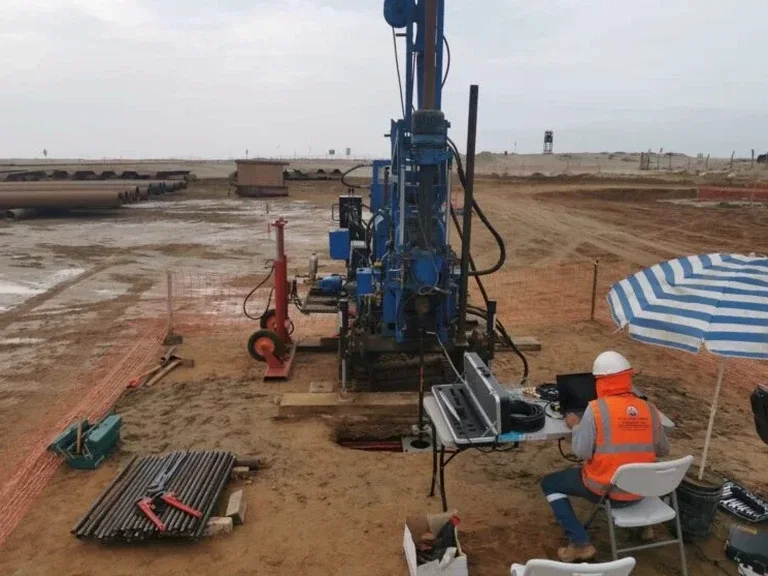
Technical reference image — West Valley City

Local geotechnical context

West Valley City’s subsurface is dominated by the Lake Bonneville deposits: stiff clays interspersed with silty sand stringers and occasional gravel lenses near the shoreline terraces. The water table typically sits between 1.5 and 3 meters below grade across much of the valley floor. These conditions create two distinct CPT risks. First, refusal on unexpected gravel can damage the cone tip if the operator pushes without monitoring sleeve friction trends — our crew watches the real-time log and stops before sensor overload. Second, drained penetration through silty layers generates negligible excess pore pressure, which can mislead an inexperienced interpreter into classifying the material as clay. We cross-check pore pressure response against friction ratio and run dissipation tests at multiple horizons to confirm drainage behavior. In seismic design categories D and E under ASCE 7, the CPT thin-layer detection capability becomes critical for identifying liquefiable lenses that the simplified Seed-Idriss approach would otherwise average out.

Need a geotechnical assessment?

Reply within 24h.

Email: info@geotechnicalengineering.sbs

Technical parameters

ParameterTypical value
Cone capacity20 tonnes (push force)
Typical depth range in basin soils30–40 m below grade
Parameters recordedqc, fs, u2 (pore pressure)
Standard followedASTM D5778-21
Soil behavior type outputSBTn chart (normalized)
Pore pressure dissipation testst50, coefficient of consolidation
Reporting turnaround48 hours for standard sites

Other technical services

01

Seismic CPT (SCPT)

A geophone module installed behind the cone measures shear wave velocity at 1-meter intervals, providing Vs profiles for ASCE 7 site classification without a separate borehole geophysics crew.

02

CPT with pore pressure dissipation

At pre-selected depths the penetration stops and we record pore pressure decay over time. This yields in-situ consolidation coefficients that replace lab oedometer tests for settlement rate predictions.

03

Liquefaction screening package

Full processing of CPT data through the Boulanger-Idriss (2014) and Robertson (2009) triggering procedures, with post-triggering settlement and lateral spreading indices mapped by depth.

Applicable standards

ASTM D5778-21 (CPT procedure and data reduction), ASCE 7-22 (seismic site class determination from CPT), IBC 2021 (foundation investigation requirements)

Common questions

How much does a CPT test cost in West Valley City?

Single CPT soundings in West Valley City typically range from US$150 to US$260 per location, depending on depth, site access, and whether SCPT or dissipation modules are included. Mobilization is quoted separately based on distance and number of soundings per day.

How deep can CPT go in Lake Bonneville clays?

Our 20-tonne rigs routinely reach 30 to 40 meters in the stiff Lake Bonneville clays found across West Valley City. Depth is limited by cone refusal on gravel lenses or by the push capacity of the rig when sleeve friction accumulates over long penetrations.

Can CPT replace SPT borings for foundation design in West Valley City?

CPT provides continuous soil behavior type and engineering parameters that often reduce the number of SPT borings required, but we typically recommend at least one SPT boring per site to calibrate soil classification with physical samples, especially when gravel content is suspected.

What soil types can CPT identify in this area?

The Lake Bonneville sediments encountered in West Valley City include soft to stiff clays, silts, silty sands, and occasional gravels. The CPT Soil Behavior Type (SBTn) chart reliably distinguishes these materials using normalized tip resistance and friction ratio, though gravelly layers may cause elevated tip resistance that requires experienced interpretation.

How soon do I get CPT results for my project?

Standard CPT reporting for West Valley City projects is delivered within 48 hours of field completion. The report includes corrected tip resistance, friction ratio, pore pressure profiles, and SBTn classification plots ready for direct use in foundation and seismic design calculations.
Location and service area

We serve projects in West Valley City and surrounding areas. More info.

View larger map