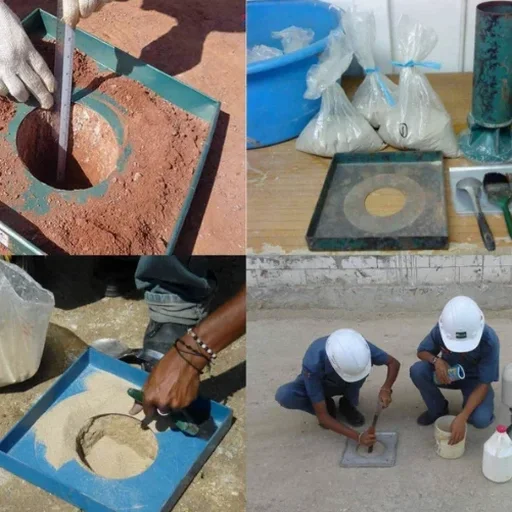
A common call we get from West Valley City comes right after a failed compaction lift. The contractor is frustrated, the inspector is holding the schedule, and nobody wants to hear that the nuclear gauge needs recalibration. That is when a straightforward sand cone test becomes the fastest path to resolution. In West Valley City, where the Lake Bonneville clays transition into coarser alluvial deposits near the Oquirrh foothills, compaction behavior shifts block by block. A density test run at a pad off 5600 West can return different moisture-density curves than one near the Decker Lake basin. The sand cone method (ASTM D1556) gives us a direct measurement of in-place density — no radioactive source, no calibration drift, just a physical volume replacement that holds up to scrutiny from the city inspector. For sites where the fill includes silty clays with occasional gravel lenses, knowing the grain size distribution before compaction starts saves rework later.
Physical volume replacement with calibrated sand eliminates the variables that plague nuclear gauges in high-moisture fills.
Process and scope
The contrast between east-side and west-side West Valley City is underrated. Near the Jordan River, subgrades tend toward finer, high-plasticity silts that hold moisture stubbornly. Out west toward the Kennecott bench, the material shifts to a sandier, well-graded mix that compacts predictably — but only when the moisture is right. A sand cone test on a utility trench along Parkway Boulevard will often show passing density at 95% of modified Proctor, while the same effort off Redwood Road produces marginal results because the fill is wet of optimum. This variability is why we pair field density with
Atterberg limits on the same material: if the plasticity index runs above 15, expect compaction challenges. The sand cone itself is simple — a calibrated jar, standard Ottawa sand, a base plate leveled on the compacted surface — but interpreting the result requires knowing the geology. West Valley sits on lacustrine sediments that can fool a gauge. When the spec calls for 95% relative compaction under IBC Chapter 18, the sand cone delivers a defensible number. For deeper verification, some projects combine surface density with an
SPT drilling program to correlate blow counts with fill stiffness in the same lift.