Geotechnical Engineering in West Valley City

Together, we solve the challenges of tomorrow.

LEARN MORE →

The subsurface conditions in West Valley City change radically depending on whether you are east of the Bangerter Highway or closer to the Jordan River corridor. Near the Oquirrh foothills, we typically encounter stiff clays and gravels that can support significant loads, but drive only a mile west toward the river and you are suddenly dealing with compressible silts and saturated sands. This variation means that a generic soil mechanics study based on county-wide assumptions is practically useless for a specific lot. Our team runs the full suite of index and strength tests, from Atterberg limits to consolidated-undrained triaxial, to build a site-specific model before any foundation is designed. When we see shallow groundwater in the valley basin, we often pair the standard investigation with a liquefaction screening because much of West Valley City sits on deposits that the Utah Geological Survey classifies as potentially susceptible during a Wasatch Front seismic event.

The Lake Bonneville clay in West Valley City can lose over 40% of its undrained shear strength when remolded, making undisturbed sampling absolutely critical.
Geotechnical Engineering in West Valley City
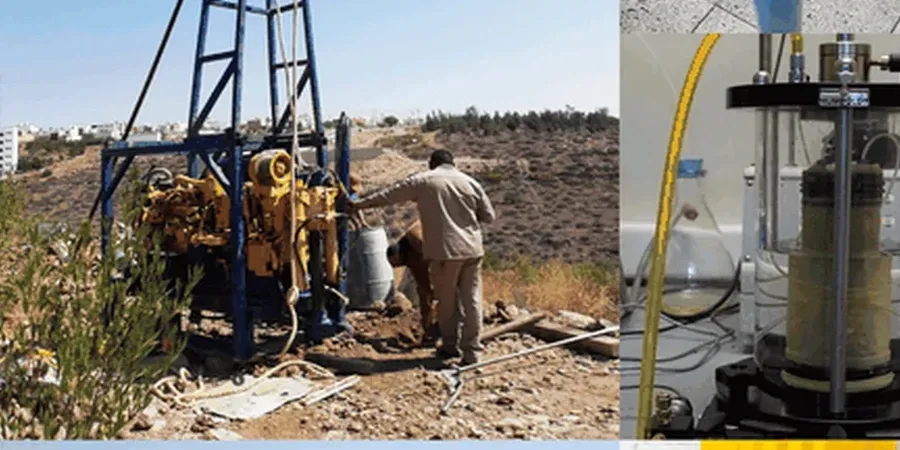
Technical reference image — West Valley City

Process and scope

A common mistake we see in West Valley City is when a contractor excavates for a retaining wall and assumes the gray clay they hit at three feet is uniform across the entire site. The Lake Bonneville sediments that underlie most of the city are notoriously layered, with lenses of clean sand interspersed between fat clay strata, and that layering creates differential settlement risks that only a proper soil mechanics study can quantify. We perform consolidated-drained direct shear on undisturbed Shelby tube samples to measure effective friction angles for each stratum, because using a single phi value across a layered profile leads to overly optimistic stability calculations. In projects where the cut extends below the groundwater table, we also run in-situ permeability tests to design the dewatering system, which is almost always necessary on the western side of the city during spring runoff months.

Local geotechnical context

A six-story mixed-use building along 3500 South had foundation plans based on a preliminary report that assumed stiff clay to a depth of twenty feet. When we drilled deeper for the final soil mechanics study, we found a ten-foot layer of loose, saturated silt at twenty-two feet that the initial investigation had completely missed. That layer would have settled unevenly under the building’s footprint, cracking partition walls and racking the elevator shaft within the first five years. The structural engineer redesigned the foundation with a mat foundation system after we provided corrected SPT N-values and consolidation parameters for the silt. In West Valley City, the cost of skipping a thorough investigation is not theoretical. It shows up as litigation and repair bills that dwarf the original testing budget.

Need a geotechnical assessment?

Reply within 24h.

Email: info@geotechnicalengineering.sbs

Technical parameters

ParameterTypical value
Standard Penetration Test (SPT) N60Reported per ASTM D1586 with energy correction
Undrained Shear Strength (Su)From unconfined compression (ASTM D2166) and field vane
Effective Friction Angle (Φ')Consolidated-drained triaxial (ASTM D7181) or direct shear
Compression Index (Cc)One-dimensional consolidation test (ASTM D2435)
Soil ClassificationUnified Soil Classification System per ASTM D2487
Groundwater MonitoringStandpipe installation and seasonal water level tracking
Liquefaction PotentialSeed & Idriss simplified procedure, Magnitude 7.0 scenario

Other technical services

01

Laboratory Strength and Consolidation Testing

We run triaxial compression, direct shear, and one-dimensional consolidation tests on Shelby tube samples retrieved from the specific strata that will carry foundation loads. Results are interpreted for both short-term (undrained) and long-term (drained) conditions.

02

Bearing Capacity and Settlement Analysis Reports

The final deliverable provides allowable bearing pressures calculated using both Vesic and Meyerhof methods, total and differential settlement predictions, and specific recommendations for foundation type and depth, all referenced to the IBC 2021.

Applicable standards

ASTM D1586: Standard Test Method for Standard Penetration Test (SPT) and Split-Barrel Sampling of Soils, ASTM D2487: Standard Practice for Classification of Soils for Engineering Purposes (Unified Soil Classification System), IBC 2021 Section 1803: Geotechnical Investigations, ASCE 7-22 Chapter 20: Site Classification Procedure for Seismic Design

Common questions

What does a soil mechanics study cost for a typical West Valley City commercial lot?

For a standard commercial lot in West Valley City with one drill rig mobilization, laboratory testing on selected samples, and a stamped engineering report, the study typically ranges from US$2,730 to US$4,890. The final figure depends on the number of borings, the depth of the investigation, and the complexity of the lab program required by the structural engineer.

How deep do you drill for a soil mechanics study in the Lake Bonneville deposits?

The boring depth is set by the foundation type and the stress bulb. For shallow footings, we extend borings to at least two times the footing width below the bearing elevation. For deep foundations like driven piles or drilled shafts, we follow IBC 2021 requirements that mandate exploring to a depth where the added vertical stress is less than ten percent of the existing effective overburden pressure, which in West Valley City often means thirty to fifty feet or more.

Do you handle the permit coordination with West Valley City for the geotechnical report?

We prepare the report in the format that West Valley City’s building department expects, with all required ASTM test summaries, boring logs, and design parameters clearly tabulated. The report is signed and sealed by a Utah-licensed professional engineer. While we do not submit the building permit application on your behalf, our reports are structured to streamline the plan check review and typically require no supplemental data when the scope is agreed upon in advance.
Location and service area

We serve projects in West Valley City and surrounding areas.

View larger map