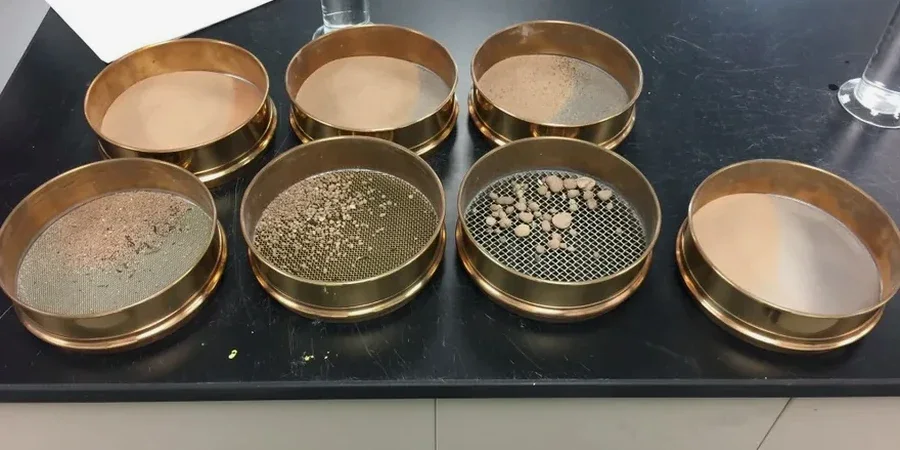
West Valley City sits on the eastern edge of the Bonneville Basin, where soils shift from lacustrine clays near the old shoreline to coarser alluvial fans pushing out from the Oquirrh Mountains. Contractors here learn fast that assuming uniform sand across a half-acre lot is a gamble. We run the full mechanical sieve stack plus hydrometer on every sample because skipping the fines fraction means misclassifying silty sand as clean fill. For deeper exploration before foundation design, a CPT test gives us continuous tip resistance and sleeve friction, pairing well with lab grain size curves to nail down liquefaction susceptibility in mapped seismic zones.
A well-graded soil in West Valley City with Cu > 6 and Cc between 1 and 3 can support a spread footing at 3,000 psf. A poorly graded silty sand at the same site might drop below 1,500 psf.
Process and scope
The USCS classification drives everything in West Valley City: cut slope angles, drainage design, and bearing capacity assumptions. Our procedure follows ASTM D6913 for the coarse fraction retained on the No. 200 sieve and ASTM D7928 for the hydrometer analysis of the minus 200 material. A typical project runs 1.5 to 2 kilograms of air-dried soil through 12 sieves, then a 24-hour sedimentation test with sodium hexametaphosphate as dispersant. We report D10, D30, D60, coefficient of uniformity, coefficient of curvature, and the full gradation curve. For road base and structural fill, we also verify compliance with local specs referencing UDOT Standard Specification Section 3015 and 3020. The hydrometer step is not optional when you are within two miles of the Jordan River corridor, where organic silts and plastic clays control drainage behavior and shrink-swell potential.
Common questions
What is the cost for a grain size analysis in West Valley City?
A standard sieve plus hydrometer package runs between US$100 and US$210 per sample, depending on whether you need the full hydrometer sedimentation or just a wash sieve. The price includes the gradation curve, USCS classification, and a brief interpretive note. Volume discounts apply for five or more samples from the same site.
How much soil do I need to bring in for the test?
Bring at least 2 kilograms of air-dried material in a sealed plastic bag. For clean gravels with particles up to 3 inches, we will need closer to 5 kilograms. If the sample is damp when you deliver it, we can oven-dry it in-house, but label the bag clearly with the depth and location.
Why do I need the hydrometer if I already ran a sieve analysis?
The sieve stops at the No. 200 opening, which is 75 microns. Everything finer passes into the pan as unknown. The hydrometer measures particle sizes from 75 microns down to about 1 micron, giving you the silt-versus-clay split. That split determines whether your fine-grained soil is a low-plasticity silt or a high-plasticity clay, which controls drainage, shrink-swell, and bearing capacity.
How do you classify the soil after the grain size analysis?
We use ASTM D2487, the Unified Soil Classification System. The percent gravel, sand, and fines from the gradation curve combine with the Atterberg limits to assign a group symbol like SP-SC or CL. The report includes the group name, such as poorly graded sand with clay, so the structural engineer has a clear picture of what the footing will bear on.