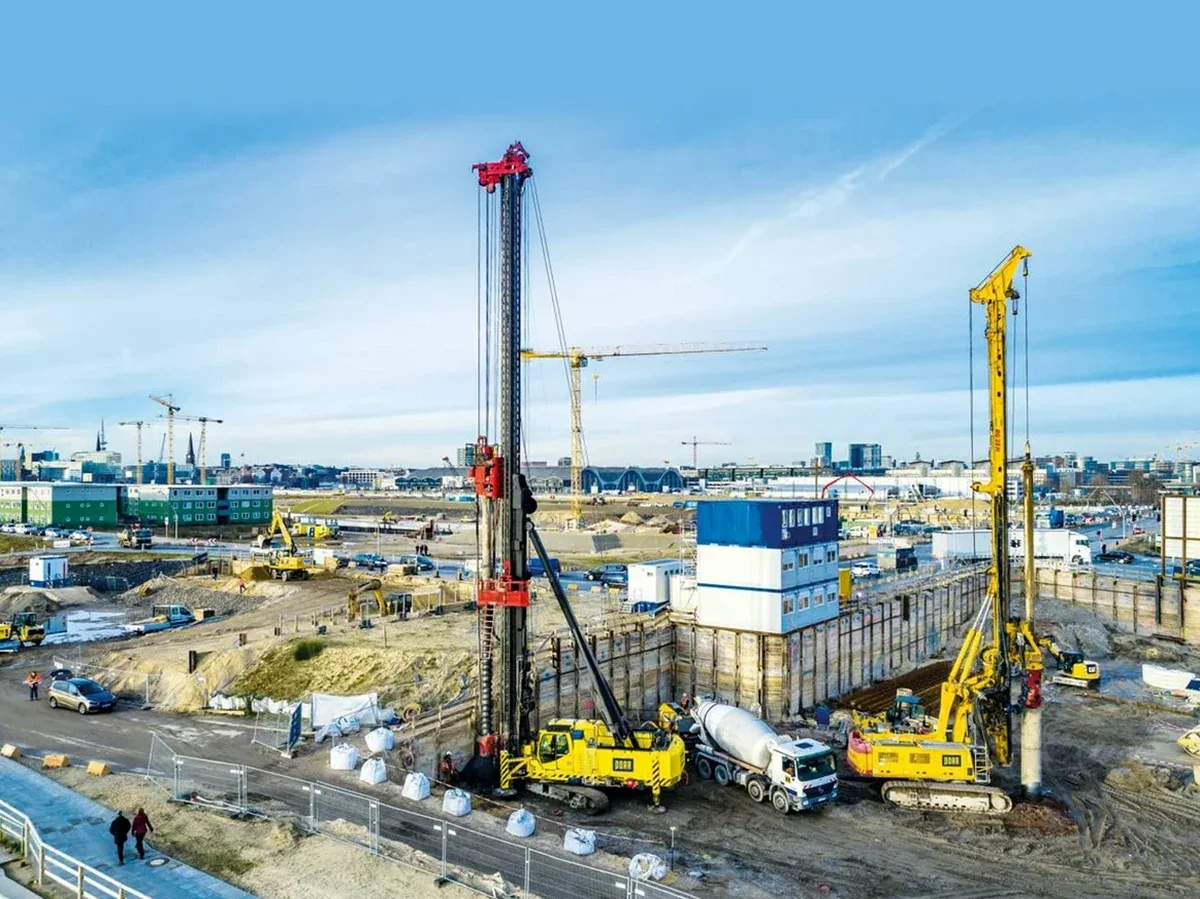
A truck-mounted auger rig advances through stiff Lake Bonneville clays near the Decker Lake margin while our logging team tracks refusal depth every 12 inches, noting the transition from desiccated crust to saturated silt. That cutoff, often between 18 and 24 feet in West Valley City, dictates whether driven H-piles or auger-cast piles become the economical choice. The pile foundation design process starts right there, with split-spoon samples and torque readings that feed directly into shaft friction and end-bearing calculations. Across the 840 square miles of Salt Lake Valley, West Valley City stands out for its rapid development over former wetlands and farmland, which means subsurface variability can shift within a single city block. Our approach integrates the CPT test for continuous tip resistance profiles in soft zones, while the SPT drilling program establishes N-values for liquefaction triggering analysis per ASCE 7-22. Each pile design we produce accounts for the city's proximity to the Wasatch Fault and the deep, compressible deposits that define the eastern Basin and Range province.
West Valley City's Lake Bonneville clays demand pile lengths that account for both static settlement and liquefaction-induced downdrag during a design-level earthquake.
Local geotechnical context
West Valley City sits on the deep lacustrine sequence of paleo-Lake Bonneville, where the groundwater table fluctuates between 4 and 8 feet across much of the valley floor. That shallow water, combined with low-plasticity silts and clays classified as ML and CL per the USCS, creates a textbook environment for earthquake-induced strength loss. The 2020 Magna earthquake, a moderate M5.7 event centered just 12 miles away, produced documented liquefaction features in low-lying areas of the valley and reminded every structural engineer in the region that pile foundations must carry axial loads through a temporarily liquefied crust. Our pile foundation design explicitly evaluates the factor of safety against bearing capacity failure under both drained long-term conditions and the undrained short-term seismic case. When the simplified procedure flags a liquefiable layer between 12 and 30 feet, we specify pile diameters and reinforcement cages that resist buckling through that zone, referencing the recommendations of Bhattacharya (2003) for slender piles in laterally spreading ground. Projects near the Jordan River corridor face additional challenges from organic silts with compression indices above 0.30, which generate significant negative skin friction that must be added to the structural load envelope.
Reference standards
ASTM D1586 – Standard Test Method for Standard Penetration Test (SPT) and Split-Barrel Sampling of Soils, ASTM D2487 – Standard Practice for Classification of Soils for Engineering Purposes (Unified Soil Classification System), ASCE/SEI 7-22 – Minimum Design Loads and Associated Criteria for Buildings and Other Structures, IBC 2021 – International Building Code, Chapter 18: Soils and Foundations, ASTM D4945 – Standard Test Method for High-Strain Dynamic Testing of Deep Foundations
Common questions
What is the typical cost range for a pile foundation design in West Valley City?
A complete pile foundation design package, including site investigation, laboratory testing, and the engineering report, typically ranges from US$1,500 to US$6,000 depending on the number of borings, pile load test requirements, and the complexity of the seismic analysis. Projects requiring dynamic pile monitoring or static load tests will fall toward the upper end of that range.
How deep do piles need to go in the Lake Bonneville clays under West Valley City?
Most pile foundations in West Valley City achieve adequate capacity between 35 and 65 feet, where the clays transition from soft to stiff consistency. The exact depth depends on the structural load per pile, the presence of liquefiable silt layers identified in the SPT profile, and the depth to gravel-bearing units at the base of the Lake Bonneville sequence, which varies across the valley.
Which pile type works best for West Valley City's soil conditions?
Auger-cast piles (ACIP) are frequently the preferred choice because they install quickly through the soft clays without casing and develop good skin friction in the stiff lower layers. Driven H-piles become more economical when the pile cap must resist high lateral loads from seismic events, while micropiles are specified for sites with limited access or where vibration during installation must be minimized near existing structures.
Does the Wasatch Fault influence pile foundation design requirements in West Valley City?
Yes. Although West Valley City is located west of the main Wasatch Fault trace, the entire Salt Lake Valley experiences amplified ground motions from basin-edge effects. Our pile designs incorporate the site coefficients for Site Class D or E from ASCE 7-22 and evaluate kinematic soil-pile interaction when the profile contains sharp stiffness contrasts that can induce bending moments in the pile during strong shaking.