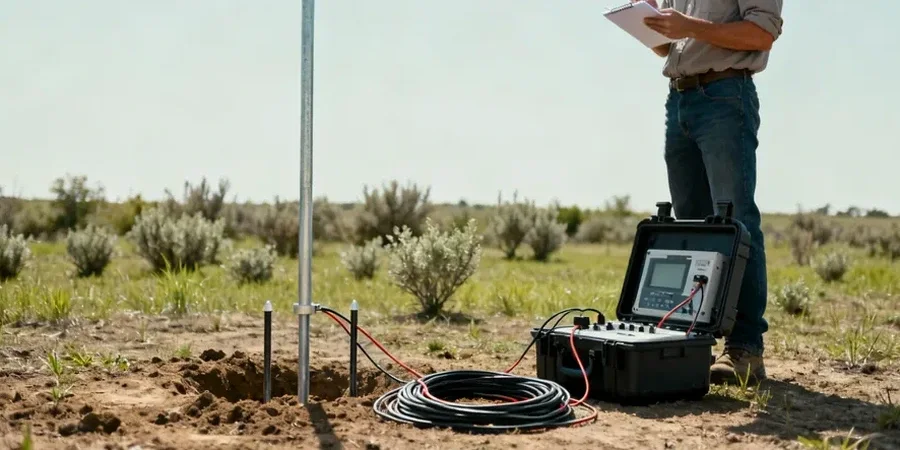
West Valley City sits on the edge of ancient Lake Bonneville. The lake left behind thick lacustrine clays and silts, interspersed with sand lenses from the Oquirrh Mountain alluvial fans. These deposits create a tricky electrical signature. Clay conducts. Sand resists. Fresh groundwater masks deep boundaries. A standard drilling program can miss the lateral changes. We use Vertical Electrical Sounding (VES) to map these contrasts fast. The method injects current and measures potential. Resistivity values build a 1D profile of the subsurface. For foundation design or groundwater exploration in the 23-square-mile city, the electrical resistivity approach cuts uncertainty before the first excavator bucket hits the ground.
In Bonneville basin sediments, a 10-ohm shift in resistivity often signals the transition from stiff clay to loose silt – a boundary that controls settlement.
Common questions
How much does a VES survey cost for a standard residential lot in West Valley City?
A typical single-family lot with four soundings runs between US$620 and US$1,030 total. The price depends on maximum depth, array length, and access constraints. We include data processing and a signed report.
How deep can you see with electrical resistivity?
Depth is controlled by the current electrode spacing. With AB/2 = 200 feet, we routinely resolve layers to 100-130 feet in Bonneville basin sediments. Deeper is possible with longer spreads if the site allows.
Can VES tell the difference between clay and silt?
Yes, if the porosity and saturation differ. Bonneville clays typically read 5-15 ohm-m when wet. Silts range 20-40 ohm-m. The contrast is clear. We calibrate against nearby boring logs whenever possible.
How long does the field work take?
Four soundings on a quarter-acre lot take about three to four hours with a two-person crew. We work around existing structures and underground utilities. Reporting takes five business days.