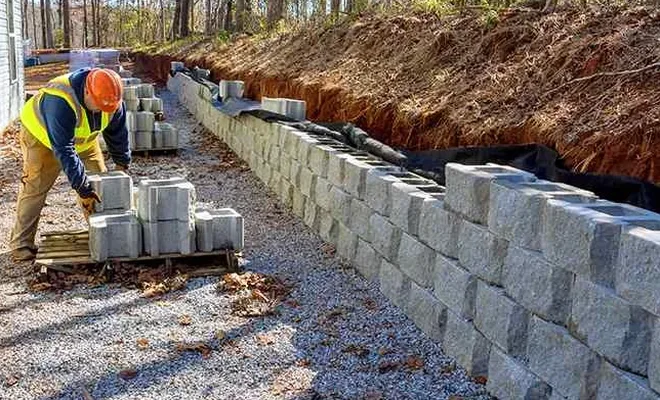
A three-tier commercial development off 5600 West ran into trouble when the excavation for the lower parking level exposed saturated Lake Bonneville silts just four feet down. The contractor had planned a standard cast-in-place cantilever wall, but the backfill pressure assumptions fell apart the moment the basin clay started weeping groundwater. West Valley City sits on a complex stack of Pleistocene lake sediments, alluvial fan gravels, and occasional fault-parallel lenses that make retaining wall design a puzzle of lateral earth pressure, drainage timing, and seismic increment. We got involved after the initial wall section showed tilt, and the fix required re-running the triaxial consolidated-undrained series to pin down effective friction angles under rapid drawdown conditions. That episode captures the reality of retaining wall design here: textbook Rankine coefficients work until the basin floor geology rewrites the problem.
Lake Bonneville clays can drop effective friction to 22 degrees when pore pressure builds behind an un-drained wall—that single parameter changes the entire stem thickness calculation.
Local geotechnical context
West Valley City sits at roughly 4,300 feet elevation where winter frost depth reaches 30 inches and summer irrigation sends water pulsing through the near-surface clays in ways that transform ordinary backfill into a surcharge nightmare. The contrast between the arid August crust and the saturated April subgrade means a retaining wall cycles through two radically different pore-pressure regimes every year. We have measured lateral earth pressure coefficients that swing from 0.35 at-rest in late summer to over 0.55 during spring thaw, simply because the drainage layer loses permeability to fines migration. Seismic demand adds another layer: the Wasatch Fault system, capable of M7+ events, imposes horizontal accelerations that turn a static wall design into a dynamic overturning check under ASCE 7-22 Chapter 11. For walls exceeding six feet, the IBC triggers a full geotechnical investigation, and skipping the site-specific response spectrum is the fastest route to a stem crack pattern that no amount of epoxy injection will hide.
Common questions
What is the typical cost range for a retaining wall design geotechnical report in West Valley City?
For a single-family lot wall under 6 feet, the investigation and report generally run between US$1,090 and US$2,300 depending on access and the number of borings. Commercial or multi-tier walls with triaxial testing and seismic analysis fall in the US$2,800 to US$4,520 range. The final figure depends on wall length, height, and whether undisturbed sampling through Lake Bonneville clay is required.
How does the IBC seismic requirement change retaining wall design for this part of the Salt Lake Valley?
IBC 2021 Section 1806.2 requires that retaining walls supporting more than 6 feet of unbalanced fill be designed for seismic earth pressure in addition to static loads. In West Valley City, the MCE spectral response acceleration at short periods can exceed 1.5g depending on site class, which translates into a significant horizontal increment applied at 0.6H above the base. We compute the pseudo-static coefficient from the ASCE 7-22 site-specific spectrum rather than using default values.
What drainage details do you recommend for retaining walls on Lake Bonneville clay?
We specify a continuous drainage blanket with a minimum permeability of 1×10⁻³ cm/s, wrapped in non-woven geotextile to prevent fines migration from the native clay. Behind the wall stem, a perforated collector pipe at the base with positive outfall to a storm drain or daylight is mandatory. For walls exceeding 12 feet, we add intermediate strip drains connected to the basal collector to intercept perched water that develops during spring irrigation.
How many borings are needed for a commercial retaining wall in West Valley City?
IBC Table 1806.2 requires at least one boring per 100 linear feet of wall, with a minimum of two borings. For walls exceeding 15 feet in exposed height, we typically recommend borings spaced at 50 to 75 feet to capture lateral variability in the Lake Bonneville deposit, particularly where gravel lenses or fault-parallel features may be present. Each boring extends to a depth of at least twice the wall height below the base of the footing.