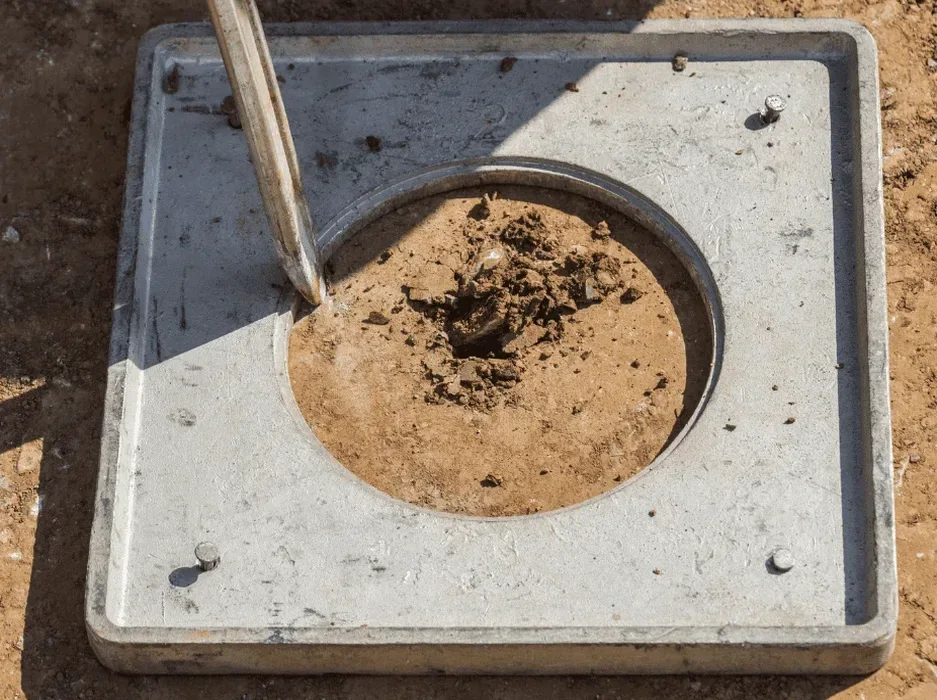
We run the SPT hammer a full 60 blows for the first six inches on a site just off Bangerter Highway, and the sampler barely advances. That dense refusal usually tells us one story, but the real question in West Valley City isn't just bearing capacity—it's what happens when the ground shakes. The valley floor sits on layers of fine sand and silt deposited by ancient Lake Bonneville, and the water table here is often within ten feet of the surface. Combine those two facts with a magnitude 6.5 scenario on the Wasatch fault, and saturated granular soils can lose all effective stress in seconds. Our laboratory, accredited to ISO 17025, runs cyclic triaxial tests on undisturbed samples to quantify that risk directly, because a foundation designed without seismic microzonation data is gambling on pore pressure behavior that no standard bearing capacity equation accounts for.
A factor of safety above 1.2 in West Valley City's silty sands doesn't mean no settlement—it means less than one inch. We design for the difference.
Local geotechnical context
A four-story mixed-use building on 3500 South had footings sized for 3,000 psf. No liquefaction study was in the original scope. During a peer review, we pulled the nearest public boring log from the Utah Geological Survey database and found a five-foot layer of loose, clean sand at 12 feet depth, directly below the water table. Our follow-up CPT sounding confirmed a cone tip resistance below 60 tsf in that layer. The post-liquefaction volumetric strain, calculated using the Ishihara and Yoshimine (1992) chart, projected over four inches of differential settlement under the design earthquake. That discovery changed the foundation system to deep piles socketed into the Lake Bonneville clays, adding cost but preventing a potential total loss. Ignoring liquefaction in the valley isn't conservative engineering—it's liability.
Common questions
What triggers a liquefaction study requirement in West Valley City?
The IBC 2021, as adopted by Utah, requires a liquefaction assessment when the mapped spectral acceleration at 1-second period exceeds 0.10g and the site contains loose to medium-dense sands below the groundwater table. Most of West Valley City sits on Site Class D with a shallow water table, triggering this requirement for structures in Risk Category II and above.
How much does a liquefaction analysis cost for a typical commercial lot?
A complete liquefaction evaluation, including two SPT borings to 50 feet, laboratory index testing, and the engineering report, typically ranges from US$2,350 to US$4,210 depending on access conditions and the depth of the liquefiable layer.
What's the difference between the simplified method and site response analysis?
The simplified method uses empirical charts (Seed & Idriss, 1971; updated by Youd et al., 2001) to estimate cyclic stress ratio from peak ground acceleration. Site response analysis models the actual soil column in software like DEEPSOIL, capturing how soft clays amplify motion at specific frequencies. We use the latter when the simplified approach yields a factor of safety between 0.9 and 1.4, where precision matters most.
Can you mitigate liquefaction risk without deep foundations?
Yes, in some cases. For sites with moderate liquefaction potential and tolerable settlement limits, ground improvement techniques like vibrocompaction or stone columns can densify the sand and carry out drainage paths for excess pore pressure. We evaluate the post-improvement settlement to confirm the solution meets the structural engineer's tolerance.